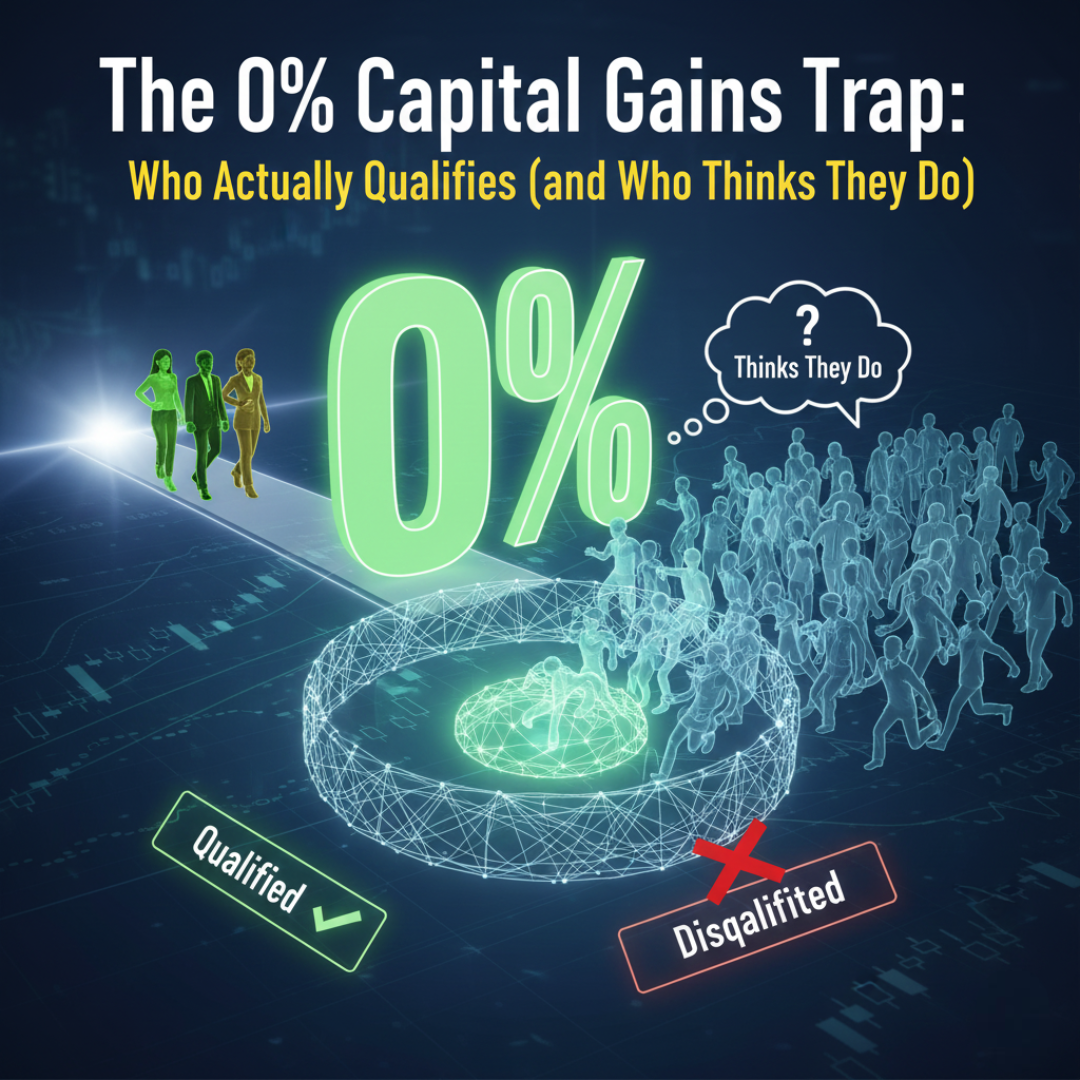
Let’s talk about one of the most misunderstood phrases in personal finance: “0% capital gains tax.”
It sounds like a loophole. A cheat code. Free money with a wink from the IRS.
And every year, thousands of people confidently sell investments thinking they qualify… only to find out later that they absolutely did not.
This is the 0% capital gains trap — and it usually snaps shut because of income stacking, dividends, and Social Security. Quiet stuff. Sneaky stuff. The kind that doesn’t feel like income until it suddenly is.
The Myth: “If My Income Is Low, My Capital Gains Are Tax-Free”
Here’s the simplified version most people hear:
“If you’re in a low tax bracket, long-term capital gains are taxed at 0%.”
That statement is technically true.
It is also dangerously incomplete.
The 0% capital gains rate only applies up to a certain income level, and that income includes far more than just your salary or pension.
The IRS doesn’t separate your income into neat emotional buckets like:
- “real income”
- “investment stuff”
- “retirement money”
It stacks everything into one tall, unforgiving number.
What the 0% Capital Gains Bracket Really Is
The 0% rate applies to long-term capital gains — assets held longer than one year.
Short-term gains are taxed like regular income. No magic there.
For long-term gains, the IRS sets income thresholds. Stay under them, and your gains may be taxed at 0%.
Cross them, even slightly, and the excess spills into higher capital gains rates.
Important detail:
These thresholds are based on taxable income, not just wages.
That’s where the trap opens.
Income Stacking: The Rule That Changes Everything
Income stacking means your income is layered in a specific order:
- Ordinary income (wages, pensions, interest, short-term gains)
- Qualified dividends
- Long-term capital gains
Your long-term capital gains sit on top of everything else.
So the question isn’t:
“Are capital gains taxed at 0%?”
The real question is:
“How much room do I have before my gains hit the ceiling?”
The Sneaky Income That Fills the 0% Bucket
This is where most people get burned.
Dividends
Qualified dividends feel harmless. Many investors barely notice them.
But they:
- Count as taxable income
- Stack before capital gains
- Eat into the 0% bracket
A portfolio throwing off dividends can quietly disqualify you from the 0% rate — even if you never sold a single share.
Social Security
This one hurts.
Depending on your total income:
- Up to 85% of Social Security benefits can become taxable
- Capital gains themselves can trigger that taxation
So selling investments can:
- Increase taxable income
- Cause more of your Social Security to be taxed
- Push you out of the 0% capital gains bracket
It’s a feedback loop. A very expensive one.
Part-Time Work or Side Income
A little consulting. A small business. A few freelance gigs.
It all stacks.
People often assume:
“I only made a few thousand — that won’t matter.”
It matters. Because it pushes your gains higher on the ladder.
A Realistic Example: Who Thinks They Qualify (But Doesn’t)
Let’s paint a familiar picture.
You’re retired.
You receive Social Security.
You have a modest portfolio.
You plan to sell some stock “tax-free.”
On paper:
- No salary
- No big income
- Feeling safe
But then:
- Dividends add income
- Part of Social Security becomes taxable
- Capital gains land on top
Result:
Only part of your gain is taxed at 0%
The rest spills into higher rates
The shock usually comes at tax time, not at the moment of sale.
Who Actually Qualifies for the 0% Rate
People who truly benefit from the 0% capital gains bracket tend to have:
- Very low ordinary income
- Minimal dividends or interest
- Careful timing of asset sales
- Strong awareness of how income stacks
Often this includes:
- Early retirees living on cash savings
- People between jobs
- Individuals in temporary low-income years
- Retirees who deliberately control withdrawals
The key isn’t wealth.
It’s income choreography.
Why This Trap Matters More Than Ever
Investment platforms make selling easy.
Tax rules do not make consequences obvious.
One click can:
- Raise your taxable income
- Affect healthcare costs
- Change benefit taxation
- Permanently increase your tax bill for the year
And once the sale happens, there’s no undo button.
How to Avoid the 0% Capital Gains Trap
This isn’t about avoiding taxes. It’s about avoiding surprises.
1. Estimate Total Income First
Before selling anything, calculate:
- Ordinary income
- Dividends
- Interest
- Social Security (taxable portion)
Then see how much room you actually have.
2. Spread Gains Over Multiple Years
Selling everything in one year is rarely optimal.
Smaller sales across multiple years can:
- Preserve 0% eligibility
- Reduce spillover into higher brackets
- Keep income predictable
3. Watch Dividend-Producing Assets
Dividends are income whether you reinvest them or not.
If you’re aiming for the 0% bracket:
- Dividend-heavy portfolios require extra caution
- Timing matters more than expected
4. Coordinate With Retirement Withdrawals
Selling investments while also withdrawing from retirement accounts can stack income faster than planned.
Sequencing matters:
Which account you tap first can change the tax outcome entirely.
This Is Why “0%” Is a Dangerous Phrase
The IRS never promised free gains.
They offered a conditional rate, with conditions buried in how income is defined and stacked.
Most people don’t fail because they’re careless.
They fail because the system is unintuitive.
Final Thoughts: The 0% Rate Is Real — but Rarely Accidental
The 0% capital gains bracket is not a myth.
But qualifying for it consistently requires intention.
It rewards:
- Planning
- Timing
- Awareness
It punishes:
- Assumptions
- Guesswork
- Last-minute selling
Before selling investments under the assumption that “it’ll be tax-free,” it’s worth running the numbers carefully.
A few minutes of planning can be the difference between:
- A clean 0% gain
- Or an unexpected tax bill that ruins the whole point of selling
Understanding the trap is the first step toward actually escaping it — legally, calmly, and without surprises.
Before selling investments under the assumption that your gains will be taxed at 0%, it’s worth running the numbers first. Small sources of income — dividends, Social Security, or part-time work — can quietly change the outcome. To get a clearer picture, you can use our Capital Gains Tax Calculator at CapitalTaxGain.com to estimate how your gains might be taxed before you make the sale.
Leave a Reply