Most people don’t sell investments because they’re excited.
They sell because they’re unsure.
Unsure what they’ll owe.
Unsure whether now is the right time.
Unsure whether the tax bill will sting… or really sting.
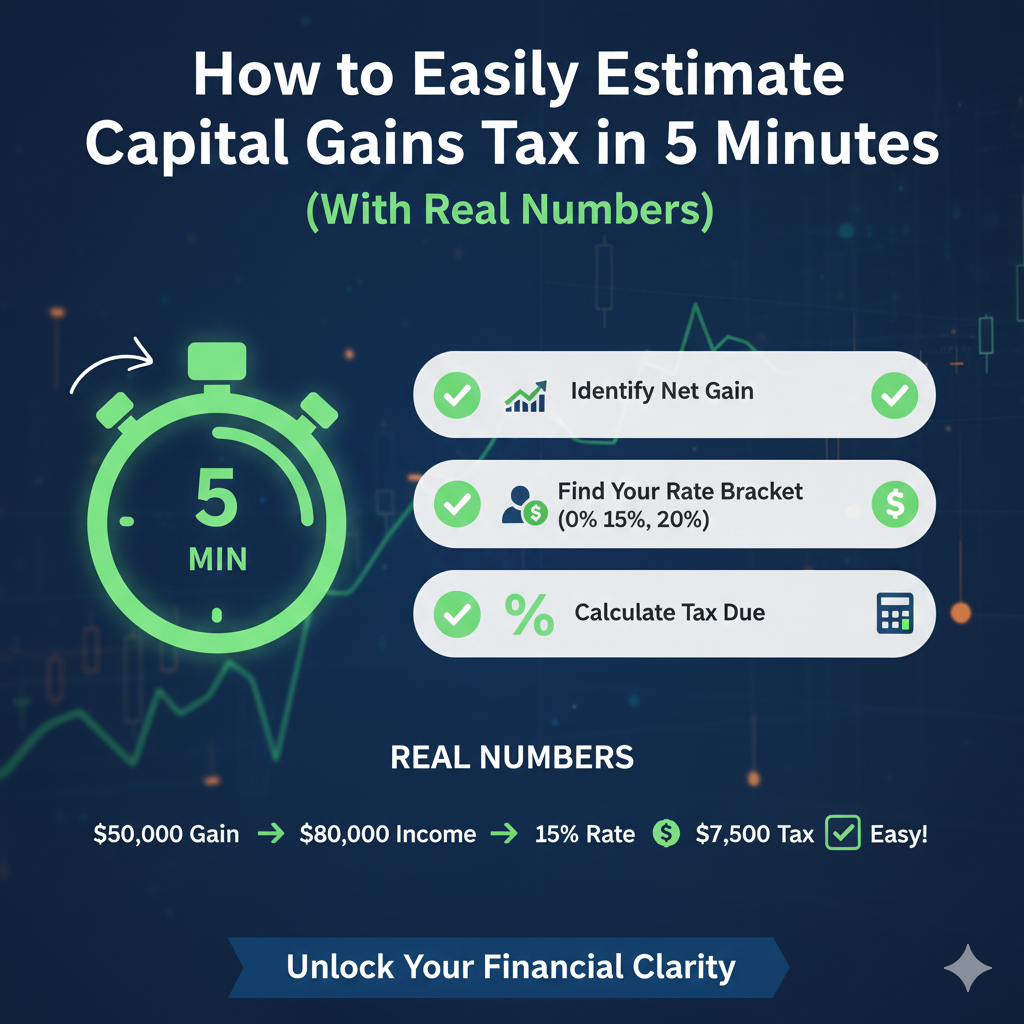
The good news is you don’t need a CPA, a spreadsheet rabbit hole, or a headache to get a solid estimate of your capital gains tax. You can do it in about five minutes — if you know what to look at and which numbers actually matter.
This guide walks through that process step by step, using real-world logic instead of tax-code gymnastics.
Why Estimating Capital Gains Before You Sell Matters
Capital gains tax is sneaky because it’s invisible until it’s not.
The sale happens instantly.
The tax arrives months later.
And by then, the money may already feel spent.
Estimating ahead of time helps you:
- Avoid selling more than you should
- Time sales across tax years
- Decide whether holding longer makes sense
- Prepare mentally (and financially) for the hit
This isn’t about avoiding taxes. It’s about avoiding surprises.
Step 1: Gather the Only 4 Numbers You Actually Need
You can ignore most of the noise. For a quick estimate, these four inputs do the heavy lifting:
- Purchase price (what you paid)
- Sale price (or expected sale price)
- Holding period (less than or more than 1 year)
- Your total income for the year
That’s it.
You don’t need your entire tax return. You don’t need deductions memorized. You just need to know where the gain sits inside your income.
Step 2: Calculate Your Capital Gain (30 Seconds)
This part is simple math:
Capital Gain = Sale Price − Purchase Price
Example:
- Bought stock for $20,000
- Selling for $35,000
- Gain = $15,000
If you reinvested dividends or paid transaction fees, those can adjust the number slightly — but for estimation, this is enough.
Step 3: Identify Short-Term vs Long-Term (Big Difference)
This is where taxes either behave… or get aggressive.
- Held 1 year or less → Short-term capital gains
Taxed like regular income - Held more than 1 year → Long-term capital gains
Taxed at special lower rates (0%, 15%, or 20%)
Most tax pain comes from accidentally triggering short-term gains without realizing it.
If you’re unsure, check the purchase date — not when you “meant” to buy it.
Step 4: Stack the Gain on Top of Your Income (The Part People Miss)
Capital gains don’t live in isolation.
They stack on top of your other income — salary, retirement income, dividends, Social Security, everything.
This stacking determines:
- Which capital gains bracket you fall into
- Whether you qualify for the 0% rate
- Whether other costs (like Medicare premiums) get triggered
Example:
- Other income: $60,000
- Capital gain: $15,000
- New total income: $75,000
Your gain doesn’t start at zero — it starts at $60,000.
This is the single most common estimation mistake people make.
Step 5: Apply the Capital Gains Rate (Rough, but Useful)
For long-term gains, the federal rates generally fall into:
- 0% for lower-income brackets
- 15% for middle-income brackets
- 20% for higher-income brackets
Short-term gains get taxed at your ordinary income rate, which can be significantly higher.
At this stage, you don’t need perfection. You’re aiming for:
- Ballpark accuracy
- Decision clarity
Knowing whether your tax bill is $1,500 or $6,000 changes behavior. That’s the point.
Real-World Scenarios (What This Looks Like in Practice)
Scenario 1: The Accidental Tax Hit
A long-term investor sells stock with a $20,000 gain during a high-income year.
Result:
- 15% capital gains tax
- Roughly $3,000 owed federally
- Plus state taxes, if applicable
They could’ve sold half this year and half next year — and paid less.
Scenario 2: The 0% Opportunity
A retiree with low taxable income sells appreciated stock.
Result:
- Entire gain taxed at 0%
- No federal capital gains tax owed
- Planning beats panic
This happens more often than people think.
Scenario 3: The Short-Term Shock
A trader sells within 11 months.
Result:
- Gain taxed at ordinary income rates
- Federal tax rate significantly higher
- Same profit, worse outcome
Timing matters.
The Fastest Way to Do This Without Mental Math
If all this still feels like too many moving pieces, there’s a simpler route.
Instead of guessing brackets or stacking numbers in your head, you can use a capital gains calculator to run the estimate in under a minute.
Plug in:
- Buy price
- Sell price
- Holding period
- Estimated income
And let the math do what math does best.
Common Estimation Mistakes to Avoid
People tend to overpay because they:
- Forget state capital gains tax
- Ignore short-term vs long-term rules
- Sell everything in one year “for simplicity”
- Assume reinvesting cancels the tax (it doesn’t)
Estimation isn’t about being perfect. It’s about not being blind.
Final Thought: Estimation Is Power
Five minutes of estimation can save:
- Thousands in taxes
- A year of regret
- Several uncomfortable surprises
Before you click “sell,” it’s worth knowing what the finish line actually looks like.
To get a fast, clear estimate without spreadsheets or guesswork, you can use our Capital Gains Tax Calculator at CapitalTaxGain.com. It’s designed to help you see the tax impact before you sell — not after the IRS does.
Planning beats reacting. Every time.
Leave a Reply