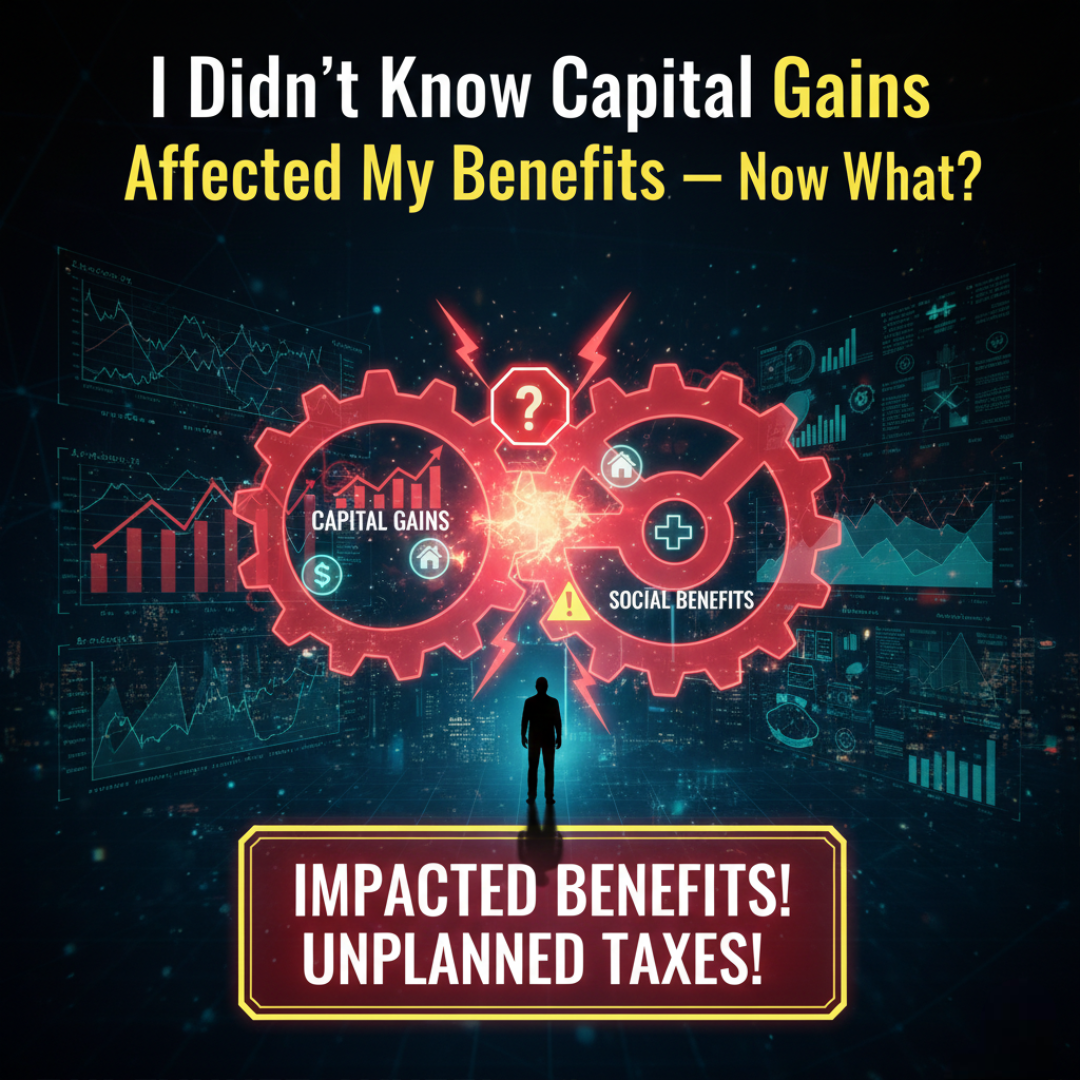
Here’s a truth that hits a lot of people way too late: capital gains don’t live in a tax vacuum.
You sell an investment.
You pay the tax.
You think the story ends there.
Then benefits you rely on — Medicare, Social Security taxation, income-based credits — quietly change. Premiums rise. Taxes creep up in places you weren’t watching. And suddenly you’re asking the same stunned question millions of people ask every year:
“Wait… I didn’t know capital gains affected my benefits. Now what?”
This article exists for that exact moment.
Not to scare you. Not to shame you. But to explain what actually happened, why it matters, and what you can still do about it — even after the sale.
Why This Catches So Many People Off Guard
Capital gains feel different from income.
They don’t come with a paycheck.
They might happen once every few years.
They often come from something emotional — a home, a business, an inheritance, a long-held investment.
So people mentally file them under “one-time event,” not “ongoing financial consequence.”
Unfortunately, the systems that calculate your benefits don’t see it that way.
To the IRS, Medicare, and Social Security, capital gains are income. And income is what determines:
- Whether Medicare adds IRMAA surcharges
- How much of your Social Security becomes taxable
- Eligibility for income-based benefits or credits
- Your effective tax rate across the board
The sale might be over in a day.
The consequences can last years.
The Domino Effect: How One Sale Changes Everything
Think of your finances like a set of stacked plates.
Your base income sits at the bottom.
Then come dividends, interest, pensions.
Then Social Security.
Then capital gains land on top of all of it.
This is called income stacking, and it’s the core reason people get blindsided.
Capital gains don’t replace income — they add to it.
That single addition can push you over invisible thresholds you didn’t even know existed.
The Most Common “Surprise Costs” People Experience
Let’s talk about the big ones — the places where people feel the pain most clearly.
1. Medicare Premiums Suddenly Go Up (IRMAA)
This is the shock that makes people feel personally attacked by the system.
Medicare Part B and Part D premiums are income-based. If your income crosses certain thresholds, Medicare adds a surcharge called IRMAA (Income-Related Monthly Adjustment Amount).
Capital gains count fully toward the income Medicare uses to calculate this.
A single large sale can:
- Push you into a higher bracket
- Increase premiums for both spouses
- Stick around for a full year or more
- Show up two years later, when you least expect it
The delay makes it feel random. It’s not.
2. Social Security Becomes More Taxable
Social Security taxation is famously confusing, but the short version is this:
The more income you have, the more of your Social Security gets taxed.
Capital gains raise your “combined income,” which can push you into a zone where:
- Up to 85% of your Social Security benefits become taxable
- Your overall tax bill jumps far more than expected
Many retirees assume their Social Security tax situation is fixed.
It isn’t.
Capital gains can quietly rewrite the math.
3. You Lose Income-Based Credits or Deductions
Certain tax credits, deductions, and benefits phase out as income rises.
Capital gains can:
- Eliminate eligibility entirely
- Reduce credits you rely on
- Increase state-level taxes or healthcare costs
Even if the gain happens once, the loss of these benefits can feel permanent — especially if you weren’t planning for it.
A Realistic Scenario (That Happens All the Time)
Picture this:
You’re retired.
Your income is modest and predictable.
You’ve structured things carefully.
Then:
- You sell $200,000 worth of stock
- Your cost basis was low
- You realize a large long-term capital gain
Tax-wise, you expected a bill. You planned for that.
What you didn’t plan for:
- Medicare premiums increasing two years later
- More of your Social Security becoming taxable
- State taxes rising
- Cash flow tightening unexpectedly
Nothing illegal happened.
Nothing unusual happened.
You just stepped on a financial landmine no one warned you about.
“Okay, This Already Happened. Now What?”
Here’s the important part: all is not lost.
What you can do next depends on where you are in the timeline.
Step 1: Confirm What Actually Changed
Before reacting emotionally, get clarity.
Look at:
- Your tax return from the year of the sale
- Your Modified Adjusted Gross Income (MAGI)
- Medicare premium notices
- Social Security tax calculations
Sometimes the increase feels bigger than it is. Sometimes it’s worse.
Either way, knowing the numbers turns panic into planning.
Step 2: Check If You Qualify for Relief or Appeals
Some benefit changes are appealable.
For Medicare IRMAA, certain life-changing events allow you to request a reduction:
- Retirement
- Loss of income
- Death of a spouse
- Divorce
- Employer pension reduction
If your income dropped after the year of the gain, you may be able to argue that the surcharge doesn’t reflect your current reality.
This isn’t automatic.
But it’s real.
And many people never try.
Step 3: Control Future Income More Carefully
Once you’ve seen how capital gains ripple through your benefits, future planning becomes clearer.
Strategies people often use after learning this lesson include:
- Spreading sales across multiple years
- Using capital losses to offset gains
- Prioritizing Roth withdrawals over taxable sales
- Selling assets in low-income years
- Timing gains before or after benefit eligibility
The mistake isn’t making money.
The mistake is making money all at once, unintentionally.
Why This Happens More Often in Retirement
During working years, high income is expected.
In retirement, income is supposed to calm down.
So when a capital gain shows up, it feels like an anomaly — but the systems calculating benefits don’t see anomalies. They see totals.
This is why retirement planning isn’t just about investments.
It’s about sequencing, timing, and tax awareness.
Selling the right asset at the wrong time can undo years of careful planning.
The Emotional Side Nobody Talks About
This part matters.
People often feel:
- Frustrated (“Why didn’t anyone tell me this?”)
- Guilty (“Did I mess this up?”)
- Anxious (“What else don’t I know?”)
That reaction is understandable — and unnecessary.
The rules are complex. They’re not intuitive. And they’re rarely explained in plain language.
This isn’t about blame.
It’s about awareness.
Turning a Bad Surprise Into a Better System
Once you know capital gains affect benefits, you’re no longer guessing.
You start asking better questions:
- “What happens if I sell this now instead of later?”
- “How does this affect Medicare or Social Security?”
- “Can I break this into pieces?”
- “What’s the long-term cost, not just the tax?”
That shift alone can save thousands over time.
Final Thoughts: This Isn’t a Failure — It’s a Wake-Up Call
If capital gains unexpectedly affected your benefits, it doesn’t mean you failed.
It means you interacted with a system that punishes ignorance more than mistakes.
The good news is that once you understand how income stacking works, how thresholds trigger costs, and how timing changes outcomes, you’re no longer flying blind.
Capital gains aren’t dangerous.
Unplanned capital gains are.
From here on out, every sale can be intentional — not reactive.
And that’s the difference between being surprised by your finances and actually being in control of them.
Before selling any major investment, it helps to see the full picture — not just the tax bill, but how capital gains might affect benefits like Medicare and Social Security too. Our Capital Gains Tax Calculator on CapitalTaxGain.com lets you estimate potential gains and taxes in advance, so you can plan smarter and avoid costly surprises after the fact.
Leave a Reply