There’s a specific kind of frustration that comes with paying capital gains tax.
You did everything “right.”
You invested.
You waited.
You sold for a profit.
And then the tax bill shows up and quietly eats a chunk of your win.
Tax-loss harvesting exists for exactly this moment — not as a loophole, not as a trick, but as a built-in feature of the tax system that surprisingly few people actually use well.
This guide is for beginners, but not beginners who want baby talk. It’s for people who want to understand what’s really happening, why it works, when it backfires, and how to use it calmly instead of panicking in December.
First: What Tax-Loss Harvesting Actually Is (In Human Terms)
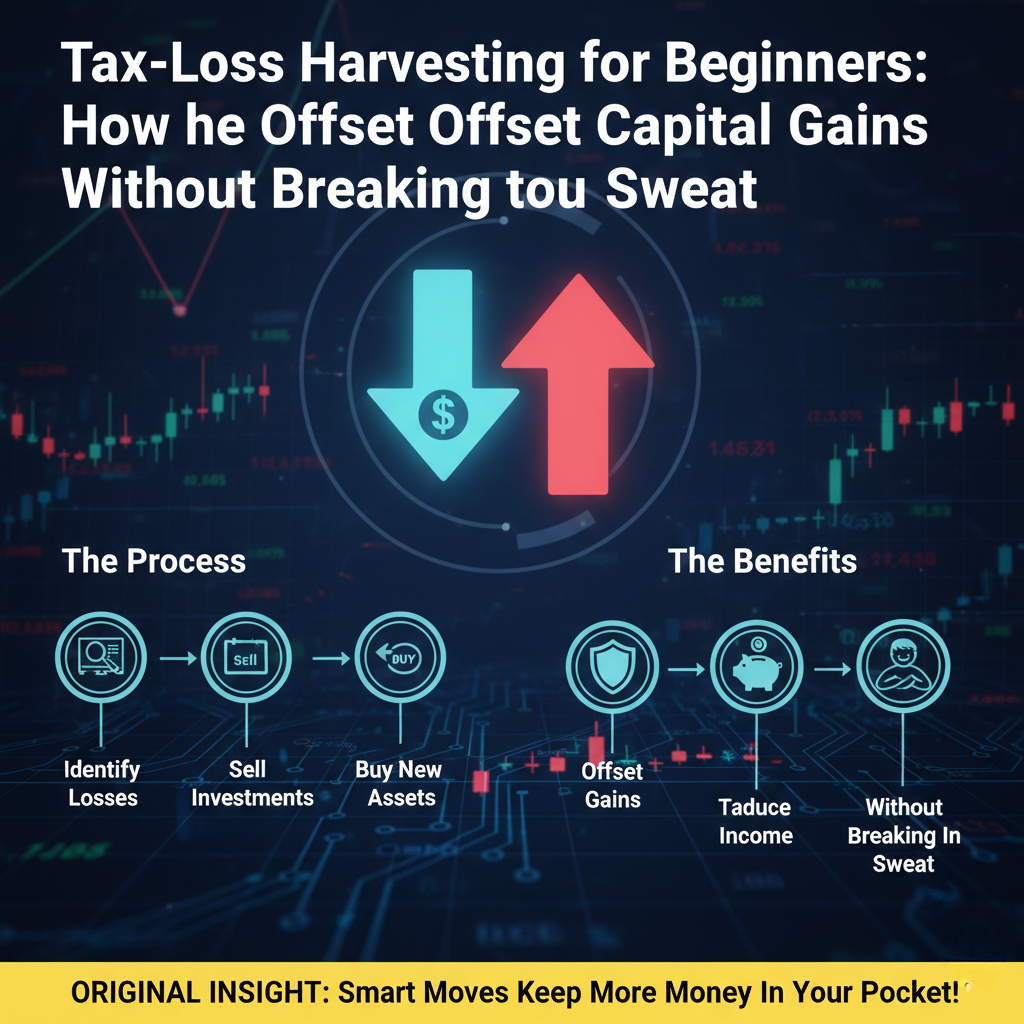
Tax-loss harvesting means selling investments that are currently at a loss in order to reduce taxes on investments you sold at a gain.
That’s it.
No shell games.
No shady maneuvers.
No “tax hack” nonsense.
The IRS allows you to subtract capital losses from capital gains. You’re simply choosing which losses to realize, and when.
The key word here is realize.
A loss doesn’t exist for tax purposes until you sell.
Why This Matters More Than People Realize
Most investors focus obsessively on returns and barely think about taxes.
But taxes are one of the few variables you can actually control.
A portfolio that earns 8% but loses 25% of its gains to taxes is not doing as well as it looks. Tax-loss harvesting reduces what’s called tax drag — the silent erosion of returns over time.
This matters even more if:
- You trade occasionally, not constantly
- You rebalance portfolios
- You sell assets for life events (retirement, home purchase, business sale)
- You’re in higher tax brackets
For long-term investors, small tax decisions compound just like gains do.
The Basic Mechanics (Without the IRS Jargon)
Here’s the simplest version of the math:
- You sell Stock A for a $10,000 gain
- You sell Stock B for a $4,000 loss
Result:
- You only pay capital gains tax on $6,000, not $10,000
Losses reduce gains dollar-for-dollar.
If losses exceed gains, you can:
- Use up to $3,000 per year to offset ordinary income
- Carry the remaining losses forward to future years
That carryforward is powerful. Losses don’t expire.
Short-Term vs Long-Term Losses (This Part Actually Matters)
Capital gains and losses are split into two buckets:
- Short-term (held 1 year or less)
- Long-term (held more than 1 year)
Short-term gains are taxed like regular income. Long-term gains usually get lower rates.
The IRS forces an order:
- Short-term losses offset short-term gains first
- Long-term losses offset long-term gains first
- Then they cross over if needed
This matters because offsetting short-term gains is often more valuable than offsetting long-term ones.
Tax-loss harvesting isn’t just about losses — it’s about which losses you realize.
The Emotional Trap: Why People Avoid Selling Losers
Let’s be honest.
People don’t avoid tax-loss harvesting because it’s complicated.
They avoid it because it feels bad.
Selling a losing investment feels like admitting failure.
Holding feels like hope.
But tax-loss harvesting reframes the situation:
You’re not “locking in a loss.”
You’re recycling a loss into a tax asset.
The market already decided the value. The only question is whether you’ll use that reality strategically.
The Wash Sale Rule (The One Rule You Can’t Ignore)
This is where people mess up.
The wash sale rule says you can’t:
- Sell an investment at a loss
- Buy the same or “substantially identical” investment
- Within 30 days before or after the sale
If you do, the loss is disallowed for now.
This rule exists to prevent fake losses — selling only for tax reasons and instantly buying back.
But here’s the part beginners often miss:
You can stay invested.
Instead of buying the exact same asset, you can buy:
- A similar ETF, not identical
- A different fund in the same sector
- A broader or narrower exposure
Example:
- Sell an S&P 500 ETF at a loss
- Buy a total market ETF instead
Market exposure stays. The loss stays valid.
When Tax-Loss Harvesting Makes the Most Sense
Not every situation calls for it.
It tends to work best when:
- You’ve realized gains this year
- Markets are volatile
- You’re rebalancing anyway
- You expect to be in similar or higher tax brackets later
- You want flexibility in future years
It’s especially powerful near year-end — but waiting until December is not required. Losses harvested earlier can be carried forward indefinitely.
A Simple Real-World Scenario
Let’s make this concrete.
You invested in three stocks:
- One doubled
- One stayed flat
- One dropped 30%
You sell the winner to fund something important.
Instead of paying tax on the full gain, you:
- Sell the losing stock too
- Capture the loss
- Reinvest in a similar asset
Your portfolio exposure barely changes.
Your tax bill drops meaningfully.
Nothing fancy happened. Just intention.
The Hidden Benefit: Smoother Future Planning
Tax-loss harvesting isn’t just about this year.
Carried-forward losses can:
- Offset gains years later
- Make future sales less painful
- Give you flexibility during retirement
- Help with large one-time events
People who consistently harvest losses often build a quiet “loss bank” that cushions future decisions.
That’s planning, not gaming the system.
When You Shouldn’t Tax-Loss Harvest
This matters too.
It might not make sense if:
- You expect much lower tax rates later
- The loss is tiny relative to transaction costs
- You’re triggering wash sale complications
- The asset is illiquid or hard to replace
Tax-loss harvesting is a tool, not a reflex.
Used thoughtlessly, it can create paperwork without real benefit.
The Big Myth: “This Is Only for Rich Investors”
False.
Tax-loss harvesting scales beautifully.
Whether your gain is $2,000 or $200,000, the math works the same. In fact, everyday investors often benefit more because a few thousand dollars of tax savings matters more proportionally.
This isn’t elite finance.
It’s basic literacy.
How This Fits Into a Bigger Capital Gains Strategy
Tax-loss harvesting works best when combined with:
- Smart timing of sales
- Understanding short- vs long-term gains
- Income stacking awareness
- Retirement planning
- Benefit thresholds (Medicare, Social Security)
On its own, it helps.
In context, it compounds.
Final Thoughts: Calm, Not Clever
The biggest mistake people make with taxes is trying to be clever.
Tax-loss harvesting doesn’t require cleverness.
It requires calm observation and timing.
Markets go up.
Markets go down.
Losses happen whether you acknowledge them or not.
The only real choice is whether you let those losses sit uselessly on paper — or quietly put them to work reducing taxes you were going to pay anyway.
That’s not aggressive.
That’s not sneaky.
That’s just paying attention.
And in a system this complex, attention is one of the most valuable assets you can have.
If you’re considering tax-loss harvesting or planning to sell investments soon, it helps to see the numbers before making any moves. Our Capital Gains Tax Calculator at CapitalTaxGain.com lets you estimate potential gains, losses, and taxes in minutes, so you can understand how decisions like harvesting losses may affect your actual tax bill — not just the theory.
Leave a Reply