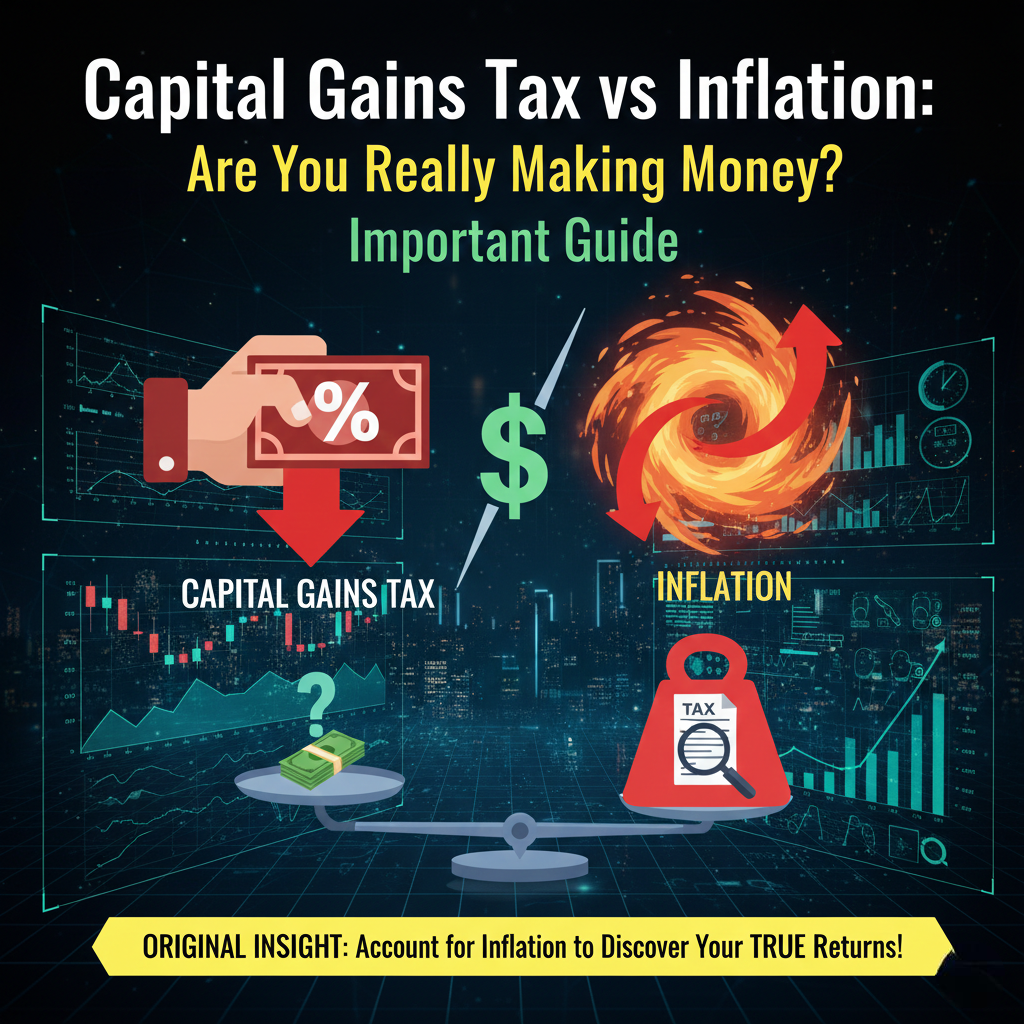
Selling an investment feels great. You see the numbers on your brokerage statement, the green keeps growing, and you think, “Yes! I’m making money!”
But then taxes arrive. And then you start thinking about inflation. Suddenly, the shiny profit doesn’t feel so shiny anymore.
That’s the tricky truth about investing: nominal gains are only part of the story. To understand whether you’re truly making money, you need to consider both capital gains taxes and inflation. Ignoring either can leave you with a lot less than you think — even after a successful investment.
This post dives into how to measure your real returns, why it matters, and practical ways to keep more of your money in your pocket.
1. Why Nominal Gains Can Be Misleading
Nominal gains are the simple difference between what you paid for an asset and what you sold it for.
For example:
- You bought 100 shares of a stock at $50 = $5,000
- You sell 100 shares at $75 = $7,500
Nominal gain = $2,500
Looks good. Right? But this is before taxes and before adjusting for inflation.
If you bought that stock 10 years ago, inflation has eroded the real value of your money. A $5,000 investment in 2015 might need to be worth $6,000 today just to break even in today’s dollars (depending on inflation rate).
The Big Problem
Many investors celebrate nominal gains without asking: “Am I ahead in real purchasing power?”
If inflation plus taxes eats up most of your gain, the excitement of seeing your brokerage balance rise is mostly psychological.
2. Understanding Real vs Nominal Returns
Nominal return: What the asset earned in dollars.
Real return: What you actually earned after adjusting for inflation.
Example:
- Investment gain (nominal): $2,500
- Inflation over 10 years: 20%
- Capital gains tax: 15% long-term rate
Let’s calculate:
- Adjust cost basis for inflation: $5,000 × 1.2 = $6,000
- Real gain before tax: $7,500 − $6,000 = $1,500
- Capital gains tax (15% of $2,500): $375
- Real gain after tax: $1,500 − $375 = $1,125
Even though it looks like a $2,500 win, your true purchasing power gain is only $1,125. That’s less than half of the headline number!
3. Why Capital Gains Taxes Make Timing Critical
Taxes aren’t just a one-time bite — they affect how your gains compound over time.
Long-Term vs Short-Term
- Short-term gains: Taxed at your ordinary income rate (up to 37% federally)
- Long-term gains: Taxed at preferential rates (0%, 15%, or 20% federally, plus 3.8% for Net Investment Income Tax if applicable)
The difference is huge. Selling the same stock after 1 year vs 5 years could change your after-tax gain by thousands.
Example:
- Stock nominal gain: $10,000
- Short-term tax: 35% → $3,500
- Long-term tax: 15% → $1,500
- Difference in after-tax gain: $2,000
Combine that with inflation, and your real wealth growth could be surprisingly small if you sell too early.
4. Inflation: The Silent Killer of Gains
Most investors focus on taxes but forget that inflation reduces purchasing power.
Think of it this way: $10,000 today buys more than $10,000 five or ten years from now.
- Average US inflation over the past 10 years: ~2–3% per year
- Over 10 years at 2.5% average: $10,000 → $12,800 in “real dollars”
- Your $10,000 gain may feel impressive, but it might only keep up with inflation, leaving you with little net benefit
Key takeaway: Nominal gains must be compared to inflation-adjusted dollars to measure real success.
5. Strategies to Keep More After Tax and Inflation
Knowing your gains might be eaten by inflation and taxes isn’t just depressing — it’s actionable. Here’s how investors protect themselves:
1. Hold Investments Longer
- Benefit from long-term capital gains rates
- Give gains time to outpace inflation
2. Tax-Loss Harvesting
- Offset gains with losses from other investments
- Reduces your taxable income and lowers effective tax rate
3. Use Tax-Advantaged Accounts
- Roth IRAs, Traditional IRAs, and 401(k)s shelter gains
- Avoid realizing capital gains in taxable accounts if possible
4. Consider Inflation-Protected Assets
- TIPS (Treasury Inflation-Protected Securities)
- Real estate, which often appreciates with inflation
- Commodities like gold as a hedge
5. Spread Sales Over Multiple Years
- Avoid income stacking that pushes you into higher capital gains brackets
- Keeps your after-tax and after-inflation gains higher
6. Examples: Realistic Scenarios
Scenario 1: Long-Term Stock
- Purchase: $20,000
- Sale after 8 years: $40,000
- Inflation-adjusted cost: $25,500
- Long-term capital gains tax (15%): $3,000
- Real after-tax gain: $11,500
Scenario 2: Short-Term Stock
- Purchase: $20,000
- Sale after 1 year: $25,000
- Inflation-adjusted cost: $20,500
- Short-term capital gains tax (35%): $1,750
- Real after-tax gain: $2,750
Notice how inflation erodes both gains, but short-term taxes crush returns faster than most people anticipate.
7. Mental Shift: Stop Chasing Nominal Gains
The most important takeaway is psychological: don’t celebrate gains until they’re real gains.
Ask yourself:
- After taxes, how much did I actually keep?
- After inflation, can I buy more than I could before?
- Could I optimize timing or account placement to improve outcomes?
This mindset changes decisions — from “I’ll sell now” to “I’ll wait, tax-optimize, and plan for real growth.”
8. Tools That Make This Easy
Estimating your real returns doesn’t need to be painful. A Capital Gains Tax Calculator can help you:
- Enter your purchase price, sale price, and holding period
- Account for federal/state taxes
- Factor in long-term vs short-term rates
Combined with inflation calculators, you can finally see your true purchasing power gain.
9. Final Thoughts
Nominal gains are like the headline in a newspaper: they catch attention but hide the story.
The real story is how much actual wealth you created after taxes and inflation.
Sell too early? Taxes bite.
Ignore inflation? Your dollars might not buy as much as you think.
Fail to plan? You could miss opportunities to keep more in your pocket.
By understanding capital gains taxes, watching inflation, and planning ahead, you can turn a simple sale into a genuine increase in wealth — not just numbers on a statement.
At the end of the day, investing isn’t just about making gains; it’s about keeping and growing your real wealth in a way that survives both taxes and the invisible drag of inflatio
Leave a Reply