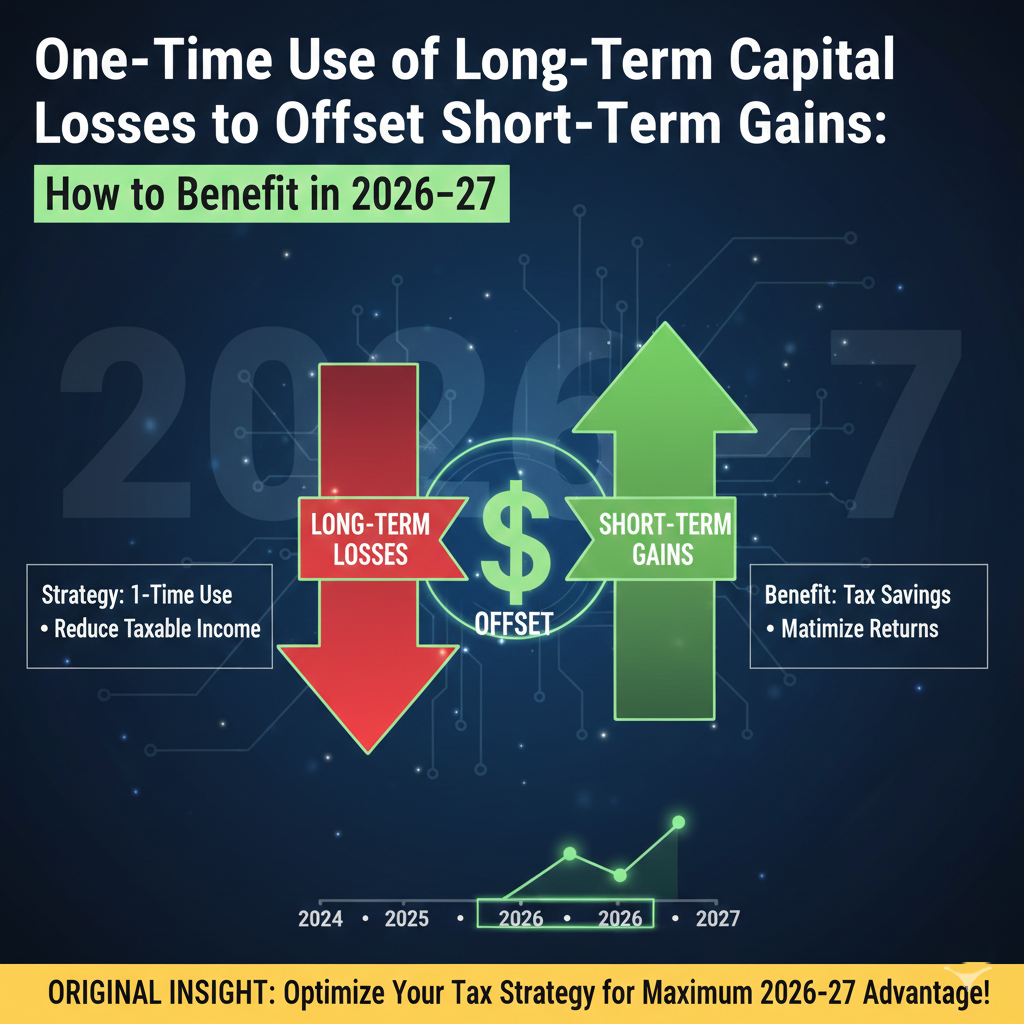
If you’ve scraped by a few investment losses over the years — maybe on a speculative bet that didn’t pan out, or an asset that never regained its value — you’ve probably wondered how to make those losses work for you rather than just haunting your tax return.
Until recently, Indian tax law had a very specific and restrictive rule: long term capital losses (LTCL) could only be set off against long‑term capital gains (LTCG). That meant if you earned profits mostly as short‑term gains — from stocks, F&O, trading, etc. — your accumulated long‑term losses sat in a corner, doing nothing to reduce tax.
But as part of the transition from the old Income Tax Act, 1961 to the new Income Tax Act, 2025, the legislature introduced a proposed one‑time relief — a transitional window — that could dramatically change this logic for the tax year 2026–27 and beyond.
We’ll unpack what that window was, why it mattered, what the final law actually says, and what you can still do to maximize your tax planning going forward.
Why This Topic Matters in 2026–27
Capital losses aren’t inherently a bad thing — they’re a tool. Under the old rules, that tool was blunt. Long‑term capital losses could only be offset against long‑term gains — which limited how quickly investors could use them. Meanwhile short‑term gains were taxed at higher effective rates, and investors sat with unused LTCLs for years.
A temporary relaxation in the original draft of the new Income Tax Bill, 2025 promised to change that bottleneck.
The idea was simple and powerful: allow long‑term capital losses incurred up to March 31, 2026 to be set off against any capital gains — including short‑term — for several years after April 1, 2026. That would give taxpayers with built‑up LTCLs actual flexibility to reduce their tax bills sooner.
That looked like a game‑changer — especially for investors entering 2026 with years of losses to their name.
But here’s the twist: that broad one‑time relief was removed in the final version of the Income Tax Act, 2025 before enactment.
So did the opportunity disappear? Not entirely — but the shape of it definitely changed.
What the Original Proposal Said (the One‑Time Window)
The draft version of the Income Tax Bill, 2025 included a transitional bolt‑on (clause 536(n)) that said something like this:
Any capital loss — long‑term or short‑term — that was computed under the old Income Tax Act and carried forward as of March 31, 2026, could be set off against income under the head ‘Capital gains’ in the new regime (for tax years starting April 1, 2026 onward) for up to eight years.
That phrasing didn’t distinguish between long‑term and short‑term gains for the purpose of set‑off. Chartered accountants and tax partners saw it as a potentially one‑time planning window that would help taxpayers with LTCLs finally absorb losses against STCGs as well as LTCGs.
Practically speaking, that meant:
- If you had built‑up LTCLs by March 31, 2026, you might be able to use them to offset STCGs after April 1, 2026.
- You could accelerate the use of those losses rather than waiting for long‑term gains to appear.
- This could lower your tax bill significantly, especially if STCGs were taxed at higher rates.
Tax experts suggested that this could change investors’ behavior: selling loss‑making assets to bring losses on books before the cut‑off, and then strategically matching those losses with future gains to reduce tax.
It was a big deal in planning circles — if it stayed in the final law.
So What Changed in the Final Law?
The version of the Income Tax Act, 2025 that was ultimately enacted did not preserve that broad relief.
Instead, the transitional saving clause now says that brought‑forward capital losses must be carried forward and set off in accordance with the repealed Act’s rules — which essentially reincorporates the old restrictions (i.e., LTCL can only be set off against LTCG, not STCG).
In other words:
- The broader one‑time relief was removed
- There is no explicit transitional relaxation permitting LTCL against STCG for 2026–27
- Brought‑forward capital losses will follow the established set‑off sequence under Section 74 of the now repealed Income Tax Act, 1961:
- LTCL only against LTCG
- STCL against both STCG and LTCG
This means the original proposal’s flexibility — which investors were mentally planning around — won’t be part of the final law.
That’s a serious clarification, and it matters for 2026–27 planning.
What This Means in Practical Terms
Let’s break down the real outcomes:
1. Long‑Term Losses Are Still Limited
Even after April 1, 2026:
- You cannot apply long‑term capital losses to reduce short‑term capital gains
- You must wait for long‑term gains before LTCLs become usable
- This was the rule before, and now it stays the rule
Taxpayers who built up LTCLs hoping to use them sooner will now need alternative strategies for 2026–27.
2. Short‑Term Losses Still Flexibly Offset
Under current law, short‑term capital losses (STCL) can be set off against both short‑ and long‑term gains:
- First, STCL offsets STCG
- Any remaining STCL can then be set off against LTCG
- Losses can be carried forward for up to 8 years if the return is filed on time
This remains one of the best tools investors have to reduce their taxable gains.
3. Loss Harvesting Still Matters — Now More Than Ever
Even without the one‑time LTCL vs STCG flexibility, capital loss planning is practical:
- Harvest losses earlier (before March 31, 2026) to maximize what can be carried forward
- File ITR on time so carry‑forward benefits aren’t forfeited
- Use STCL strategically this year to offset STCG and LTCG
Loss harvesting isn’t just tax nerd theory — it’s legally supported strategy that many traders use to reduce their overall gains tax.
But Don’t Confuse Proposal Talk With Final Reality
That Reddit conversations and earlier news articles sound enthusiastic about a one‑time set‑off opportunity — but most of them were based on the draft law.
Actual enacted legislation has taken that broader flexibility out and restored the Section 74‑like set‑off rules, meaning long‑term losses can still only be applied against long‑term gains.
This distinction is critical if you’re planning your 2026–27 tax year strategy.
What You Can Do Instead
The removal of the broader transitional set‑off doesn’t mean loss planning is useless — it means you have to be smarter and intentional:
A. Plan Your Loss Harvesting Before March 31, 2026
If you hold assets likely to generate long‑term losses, realizing those losses before the transition date still gets them on record. Once they’re on record, you can carry them forward (subject to normal rules).
B. Use Short‑Term Losses Aggressively
Short‑term losses remain highly flexible for offsetting gains with:
- Short‑term gains (first priority), then
- Long‑term gains
This is a powerful way to reduce tax in volatile markets.
C. Track Losses Across Asset Classes Carefully
Make sure your records — transaction slips, trade confidants, cost basis statements — are spotless, because carry‑forward benefits hinge on documentation and timely filing.
Quick Example of How Losses Are Offset Now
Suppose in the 2025–26 financial year you had:
- ₹3,00,000 in long‑term capital losses
- ₹1,50,000 in short‑term capital gains
- ₹2,00,000 in long‑term capital gains
Here’s how losses can be applied under current rules:
- Short‑term gain ₹1,50,000 gets reduced by ₹1,50,000 of short‑term losses (if any) first.
- Any STCG remaining is taxed normally.
- Long‑term gains ₹2,00,000 can be reduced using long‑term capital losses — up to the amount available.
- LTCL of ₹3,00,000 reduces LTCG ₹2,00,000 to zero,
- Carry forward ₹1,00,000 for future LTCG
This doesn’t involve STCG offset by LTCL — but it does show how capital losses still reduce your tax load if applied strategically.
What This Means for 2026–27 Tax Planning
The one‑time window many hoped for might not exist anymore, but the conversation highlights something important:
Capital loss planning can be one of the biggest levers you control before the taxman takes his share.
Key planning principles remain:
- Timing matters
- Documentation matters
- Filing on time matters
- Understanding set‑off order matters
In volatile markets, not taking advantage of loss offset provisions is like leaving money on the table.
Filing Tips to Protect Your Carry‑Forward Rights
You’ll only get the right to carry forward capital losses if:
- You file your ITR before the due date under Section 139(1)
- You accurately report your capital transactions
- You match transaction records with your ITR
Lose these steps, and even legitimate loss carry‑forwards can be forfeited.
The Bottom Line for Long Term Capital Losses
The one‑time use of long‑term capital losses against short‑term gains was a proposed relief in earlier versions of the new tax law, but it does not appear in the final Income Tax Act, 2025 as enacted.
Still, capital losses matter — and they matter a lot. Knowing how to harvest, carry forward, and match them to your gains under the actual law can save you real money.
That’s not just tax advice — it’s good financial planning.
If you want, I can also help draft a clear calculator example (with numbers plugged in) so readers can see the impact of loss set‑off planning on their own portfolios — just tell me the format.
Here’s a smooth, natural call‑to‑action paragraph you can add at the end of that blog — written for humans and designed to fit the flow of the article:
Before you make any moves based on your capital gains or losses, it really helps to see the actual numbers rather than just estimates in your head. Our Capital Gains Tax Calculator at CapitalTaxGain.com lets you plug in your sale price, cost basis, holding period, and losses to forecast what you might owe — including how set‑offs and carry‑forwards could affect your final bill. It’s an easy way to plan smarter for 2026–27 instead of being surprised at tax time.
Leave a Reply