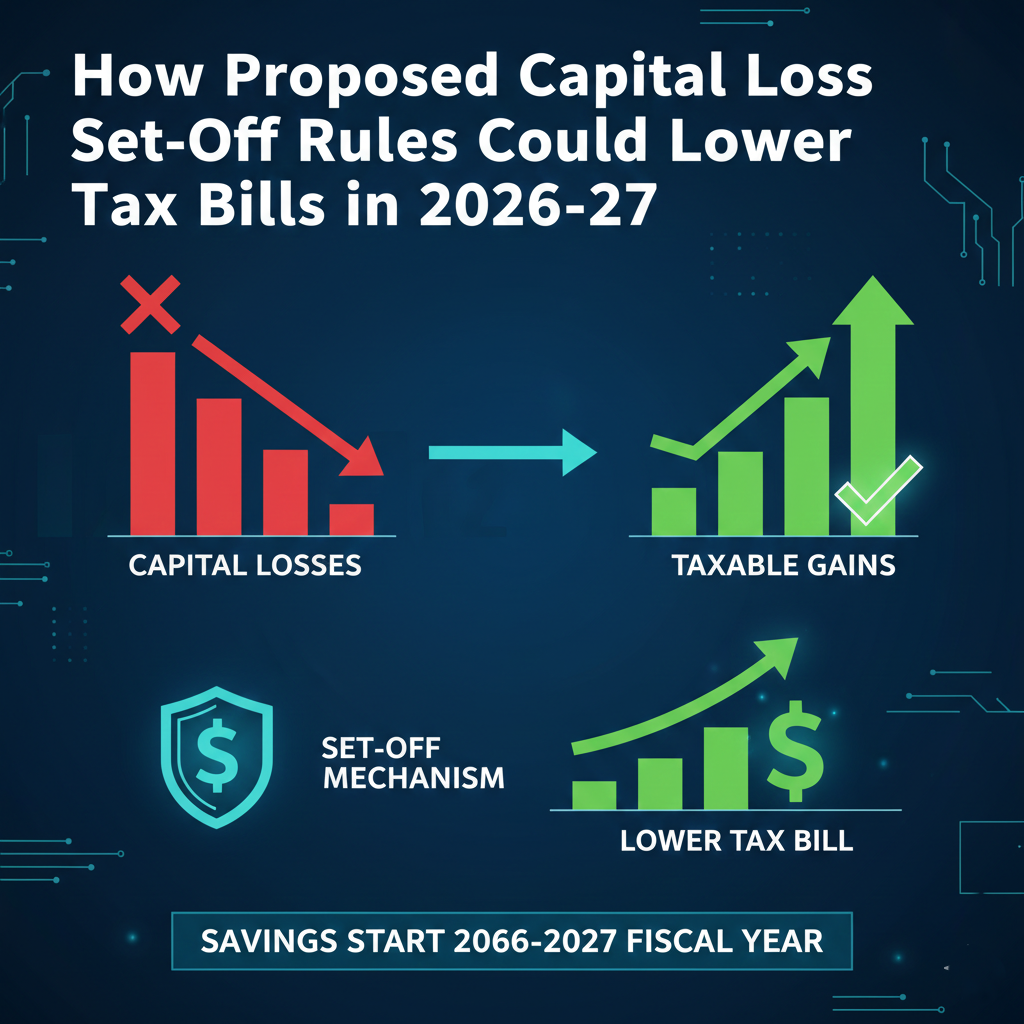
Taxes have a special talent for showing up after the damage is done. You sell one investment at a tidy profit, another at a painful loss, and the tax bill arrives like it didn’t notice the emotional rollercoaster at all. Historically, tax rules have been pretty rigid about how gains and losses can talk to each other. Short-term gains? One bucket. Long-term Capital losses? Different bucket. No mixing without permission.
Now, for 2026–27, policymakers are floating proposals that could loosen those walls — specifically, allowing long-term capital losses to offset short-term capital gains more flexibly. If enacted, this would be one of those quiet rule changes that doesn’t trend on social media but materially changes how much tax people pay.
This isn’t hype. It’s mechanics. And mechanics matter.
Let’s unpack what these proposed rules mean, why they matter, and how you can plan ahead without assuming anything is guaranteed.
First, a quick reality check
These are proposals, not settled law. Think of them as architectural drawings, not a finished building. They might pass, they might be tweaked, or they might stall entirely. Planning here is about optionality — positioning yourself so you’re ready if the rules change, without making reckless moves if they don’t.
With that caveat firmly planted, let’s get into it.
Why capital loss rules feel unfair (and kind of are)
Capital gains are usually split into two categories:
- Short-term capital gains: Profits on assets held for a short period (often under a year). These are typically taxed at higher, ordinary income rates.
- Long-term capital gains: Profits on assets held longer. These usually enjoy lower tax rates.
Losses follow similar labels. But here’s the frustration point: losses aren’t always allowed to offset gains in the most logical way.
Under many existing systems, long-term losses can be used to offset long-term gains first, and short-term losses offset short-term gains first. Cross-offsetting is limited or tightly sequenced. The result? You might be sitting on a large long-term loss while paying top-tier tax on a short-term gain.
From an economic perspective, that’s weird. A loss is a loss. The money is gone either way.
The proposed changes aim to fix this mismatch.
What’s actually being proposed for 2026–27
The headline idea is simple:
Allow long-term capital losses to directly offset short-term capital gains.
That’s it. No fireworks. No loophole-fest. Just a more rational matching of profits and losses.
Why this matters is all in the math.
Short-term capital gains are usually taxed more aggressively. If you can offset those with losses that would otherwise be “trapped” in the long-term bucket, your effective tax rate drops — sometimes dramatically.
This change wouldn’t benefit everyone equally. It favors people who:
- Actively rebalance portfolios
- Sell assets at different time horizons
- Experience volatility (tech investors, crypto holders, startup equity holders, real estate flippers who occasionally hold long)
In other words, modern investors.
A simple example (with real consequences)
Imagine this scenario:
- You sell a stock you held for 6 months and realize a $40,000 short-term capital gain
- You also sell an older investment at a $40,000 long-term capital loss
Under restrictive rules, you might not be allowed to cleanly net these against each other. That $40,000 capital gains could be taxed at a high ordinary rate, while the loss gets pushed forward into future years.
Under the proposed rules, they cancel out.
Taxable gain: zero
Tax bill: dramatically lower
Stress level: noticeably improved
Same economic outcome. Very different tax outcome.
Why governments are even considering this
This isn’t generosity. It’s modernization.
Markets today move faster than tax codes were designed for. People don’t neatly hold one asset for six months and another for six years by design — life, liquidity needs, and volatility force mixed timelines.
There’s also a fairness argument. When gains are taxed aggressively but losses are restricted in how they apply, risk-taking is penalized asymmetrically. Governments want participation in markets, not paralysis.
Allowing broader set-offs:
- Encourages rational portfolio cleanup
- Reduces tax-driven holding decisions
- Makes the tax system more economically neutral
Neutrality is the unsung hero of good tax policy.
Who stands to benefit the most
Let’s be concrete.
These proposed rules disproportionately help:
Active investors
People who rebalance, rotate sectors, or trim winners frequently. Short-term gains happen, whether they like it or not.
Startup equity holders
One exit can generate short-term income while older investments quietly go south.
Crypto traders
Timing mismatches are common. Losses often trail gains.
Real estate investors
A flipped property may create short-term gains, while an older sale produces a long-term loss.
Anyone with a “messy” portfolio history
Which is most humans, not theoretical finance textbooks.
What this does not mean
This doesn’t mean:
- Losses become unlimited free passes
- You can magically erase all tax forever
- Timing stops mattering
Caps, carryforward rules, and documentation requirements will still exist. The proposal simply removes a wall, not the entire structure.
Also important: this does not mean you should intentionally realize losses just because you might get better treatment later. That’s speculative behavior, not planning.
How to plan before the rules are finalized
This is where calm strategy beats impulsive action.
Here’s how smart investors think about proposals like this:
They don’t bet everything on them.
They don’t ignore them either.
Instead, they keep flexibility.
That means:
- Tracking unrealized long-term losses carefully
- Understanding which assets would generate short- vs long-term gains if sold
- Avoiding unnecessary forced sales that lock you into higher tax buckets today
Documentation matters too. Clean records give you options. Sloppy records remove them.
Timing becomes more powerful
If these rules pass, timing sales across tax years becomes a serious lever.
You might:
- Delay realizing a short-term gain until a year where you can pair it with a long-term loss
- Accelerate a loss realization strategically
- Net outcomes instead of treating each sale in isolation
This isn’t about gaming the system. It’s about aligning actions with reality.
Why most people will miss this entirely
Tax changes like this don’t announce themselves loudly. No fireworks. No viral outrage. Just a quiet paragraph in a bill that saves some people thousands of dollars and leaves others confused about why their neighbor paid less.
Most people react after the tax year ends. By then, choices are frozen.
The people who benefit are the ones who understood the rule before December.
The psychology angle (because money is emotional)
Losses hurt more than gains feel good. Behavioral economists have proven that again and again. When tax rules prevent losses from being fully useful, the pain is doubled — first in the market, then on the tax return.
Allowing losses to offset higher-taxed gains doesn’t just change numbers. It reduces the psychological sting of investing. That encourages participation, resilience, and smarter long-term behavior.
A tax code that acknowledges human psychology is usually a better one.
Watchpoints for 2026–27
As this proposal evolves, pay attention to:
- Whether the set-off is permanent or temporary
- Whether caps apply
- Whether carryforwards are affected
- Whether this applies retroactively or only to future tax years
Each of these details changes planning outcomes.
This is where tools — not guesses — become essential.
Planning without panic
The smartest move right now isn’t to rush. It’s to understand your current position.
Know:
- Your unrealized gains and losses
- Their holding periods
- Your marginal tax exposure
Once you see the map, adapting to new rules becomes easy. Without the map, every rule change feels like chaos.
The bigger picture
This proposed change is part of a broader trend: tax systems slowly acknowledging that modern investing doesn’t fit old boxes. Asset classes blur. Time horizons overlap. People manage portfolios, not isolated transactions.
Rules that allow losses to offset gains more rationally aren’t loopholes. They’re corrections.
If enacted, 2026–27 could quietly become one of the most tax-efficient years for investors who planned ahead.
Not lucky investors. Prepared ones.
Final thought
Tax planning isn’t about prediction. It’s about preparedness. You don’t need certainty to make smart moves — you need clarity.
Understanding how proposed capital loss set-off rules could work gives you that clarity. Whether the law changes or not, the exercise of mapping your gains, losses, and timelines already puts you ahead of the majority.
And in tax planning, being ahead is almost always cheaper than catching up.
Want to see how these proposed rules could affect your numbers?
Tax changes only matter if you understand how they apply to your own gains and losses. Our Capital Gains Tax Calculator lets you plug in your investment details and instantly estimate what you might owe — under current rules and with potential planning scenarios in mind. It’s a simple way to reduce uncertainty before you make any big selling decisions.
👉 Try the Capital Gains Tax Calculator here: Capitaltaxgain.com
One of the key reasons these set-off rule changes are drawing attention is because they’re a one-time opportunity under the transitional clauses of the new Income Tax Bill. According to Outlook Money, if you’ve incurred a long-term capital loss any time before March 31, 2026 and haven’t been able to use it due to a lack of matching long-term gains, the new provisions could let you apply those losses against any type of gain — including short-term gains — from the 2026–27 tax year onward. That kind of flexibility hasn’t existed under the older rules, and understanding it could make a significant difference in your overall tax planning.
Leave a Reply