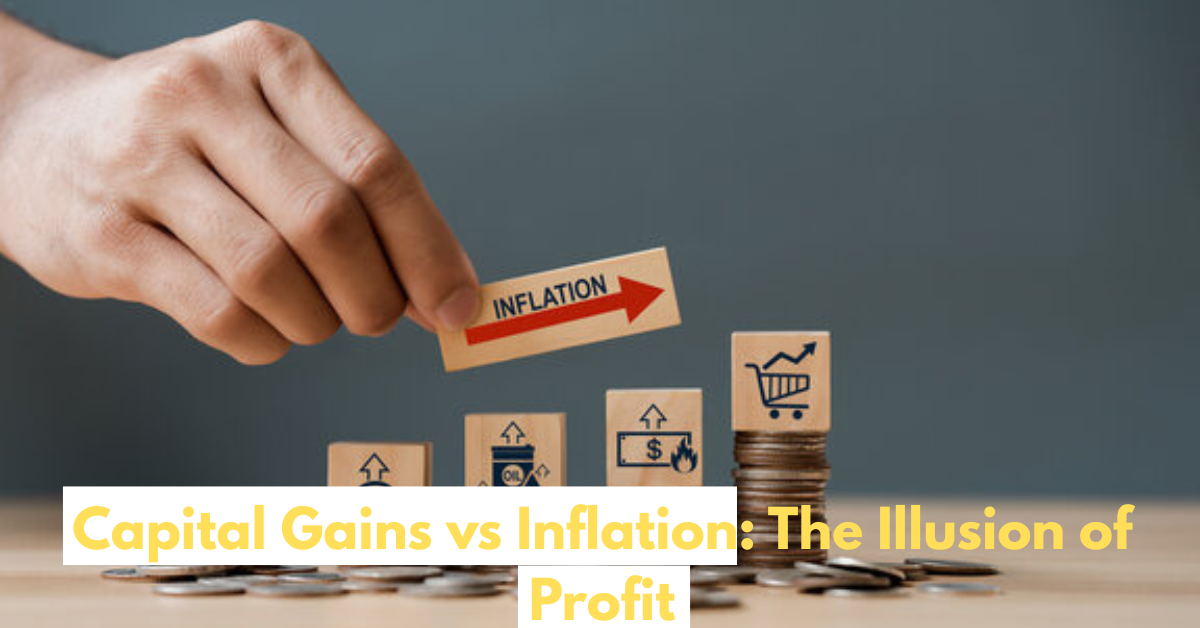
When people brag about making “10% a year” on their investments, they usually mean nominal returns—the raw numbers staring back at you from your brokerage app. Those shiny digits feel great. But here’s the catch: money doesn’t live in a vacuum. It lives in the real world, where prices rise, taxes exist (tragically), and time slowly eats away at your purchasing power.
The number your broker flashes? That’s just the surface. Your real capital gains return—the number that actually affects your life—is what’s left after inflation and taxes. And once you factor in both, that seemingly impressive return often loses a lot of its swagger.
Let’s take a closer look.
Inflation: The Silent Pickpocket
Inflation doesn’t announce itself. It doesn’t ring the doorbell and demand your cash. Instead, it sneaks in quietly, day by day, shrinking the purchasing power of every dollar you’ve worked to save. A 3% inflation rate might sound harmless—barely noticeable on your coffee bill—but over time, it’s a stealthy wealth-eater.
Imagine this:
- You have $10,000 today.
- Ten years later, assuming a steady 3% annual inflation, that same $10,000 can only buy what $7,400 could buy today.
Same money, fewer groceries, smaller vacations, tighter wallets. Inflation doesn’t care if you’re rich, poor, or somewhere in between. Its bite is subtle but relentless.
Now, let’s tie this to investing.
You might see your portfolio double over a decade. That feels amazing. But if inflation has quietly eroded a third of your purchasing power over the same period, your “huge gain” isn’t quite so huge anymore. Your account balance looks healthy, but the lifestyle it supports? Less so.
Capital Gains Tax: Inflation’s Evil Twin
Here’s where it gets really tricky. Inflation slowly eats your real wealth, and the IRS taxes your nominal gains, not your real gains. That means you pay tax on “profits” that, in real terms, barely exist.
For example:
- You buy a stock for $10,000.
- Several years later, you sell it for $16,000.
Your nominal gain is $6,000. Great, right? But if $3,000 of that increase is purely due to inflation, your real gain is only $3,000.
The IRS doesn’t care. You’re taxed on the full $6,000. That hidden tax drag is exactly why many investors feel like they’re working harder than they actually are. Inflation quietly devalues your money, and the tax system happily takes a cut from what may not even be “real” profit.
The Long-Term Capital Gains Trap
“But wait,” you protest, “long-term capital gains rates are lower!” True. They’re often 0%, 15%, or 20% depending on your income. Compared to ordinary income tax, that’s generous. But here’s the catch: combine inflation with capital gains tax, and your return gets quietly eaten alive over time.
Let’s illustrate with a realistic scenario.
Scenario 1: The ‘Respectable’ Investor
- Annual return: 7%
- Inflation: 3%
- Capital gains tax: 15%
- Holding period: 20 years
At first glance, a 7% return looks solid. But let’s adjust for inflation and taxes:
- Inflation adjustment: 7% nominal return minus 3% inflation = 4% real return.
- Tax adjustment: Capital gains tax further reduces that 4% real return by 15% → effective after-tax, after-inflation return ≈ 3.4%
Over two decades, that small difference compounds. Your “doubling portfolio” narrative becomes less dramatic once reality bites. Taxes and inflation together can eat 30–50% of your total gains over the long term. That’s not a rounding error; it’s a structural leak in the system.
Why Long-Term Investors Feel Rich But Aren’t
This math explains a common disconnect in investing psychology. Account balances go up, yes. But real purchasing power often lags. Expenses that grow faster than inflation—housing, healthcare, education—can make even a portfolio that doubled feel inadequate.
You’re technically wealthier. Functionally, you might be treading water. This isn’t a critique of investing strategy—it’s a reminder that headline numbers lie without context.
The Compounding Cost of Ignoring Taxes
Taxes don’t just subtract once; they interrupt the magic of compounding. Every dollar lost to taxes:
- Stops growing
- Stops generating more gains
- Never comes back
Over decades, this lost compounding effect can rival inflation itself. Two investors with identical portfolios could end up with radically different outcomes just based on tax efficiency. It’s like one is swimming with a backpack full of lead while the other has none.
How Smart Investors Reduce the Inflation + Tax Double Hit
No one’s talking about dodging taxes (that’s illegal and painful). The goal is understanding the mechanics and optimizing within the rules. Here’s what informed investors often do:
- Timing sales to stay within the 0% capital gains bracket.
- Tax-loss harvesting: selling underperforming investments to offset gains.
- Using tax-advantaged accounts (like IRAs, 401(k)s, or ISAs in the UK).
- Selling gradually, not all at once, to avoid a huge lump-sum tax hit.
- Focusing on inflation-adjusted returns, not just nominal growth.
None of this requires genius, just awareness. It’s the difference between blindly following your brokerage app and actually knowing how much purchasing power your investments are adding.
The Question You Should Actually Ask
Instead of obsessing over “How much did my stock go up?”, ask:
“How much purchasing power did I gain after inflation and taxes?”
This is the real measure of wealth. The nominal gains are just numbers on a screen; what matters is what you can actually spend, save, or enjoy.
Numbers Can Lie Without Context
Capital gains tax and inflation don’t scream. They whisper. They nibble. Over years and decades, they patiently erode value while investors focus on green arrows and portfolio charts.
Long-term investing still works, and markets do reward patience. But real wealth isn’t about the headline figure; it’s about understanding what you truly keep. Money is slippery that way. It rewards those who look beneath the surface.
For anyone wondering how timing and type of sale affect taxes, check out our guide on short-term vs long-term capital gains. Knowing the difference can literally save you tens of thousands over a lifetime of investing.
Final Thoughts on Capital Gains vs Inflation
Investing isn’t complicated; understanding the real return is. Inflation and taxes are quiet, invisible forces that can undermine your financial plans. The solution isn’t panic—it’s perspective.
- Track real, after-tax gains.
- Plan sales strategically.
- Use tax-advantaged vehicles when possible.
- Don’t be seduced by big nominal numbers.
The market rewards patience and consistency, but true wealth comes from knowing what you actually keep. That’s the math no one talks about at cocktail parties, but it’s the difference between feeling rich and actually being rich.
Leave a Reply