Retirement doesn’t usually fail because of bad investing.
It fails because of bad sequencing.
Not market crashes.
Not inflation alone.
But which money you pull, when you pull it, and how that choice quietly snowballs over 20–30 years.
This is called sequence risk, and it’s the reason two retirees with the same savings can end up in wildly different financial realities.
One of the most overlooked decisions inside that risk:
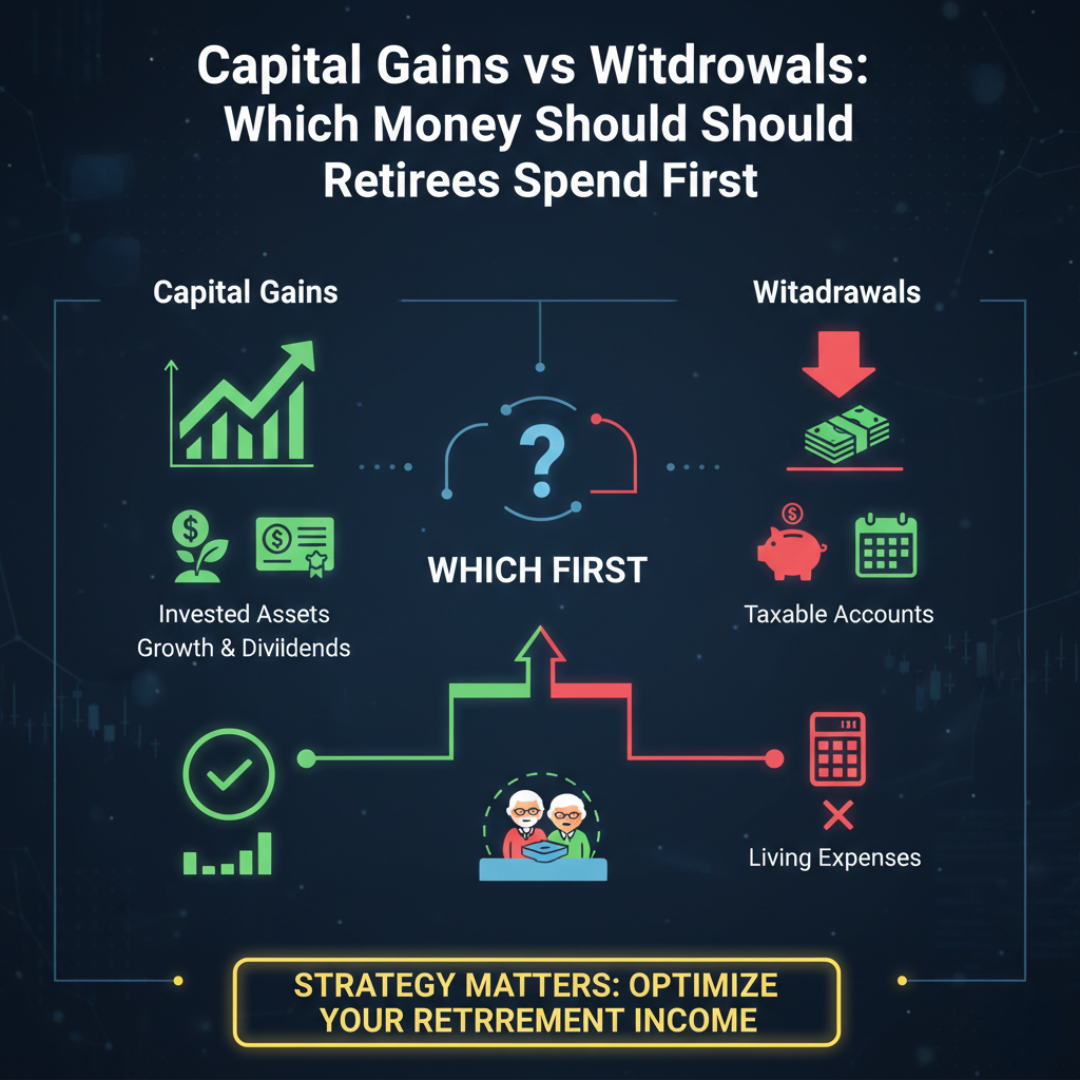
Should you spend money from investments with capital gains first — or from retirement accounts via withdrawals?
There’s no universal answer. But there is a logic to it. Let’s walk through it.
Why This Question Matters More Than Most People Think
On paper, money is money.
In retirement, money has personality.
Some dollars trigger taxes immediately.
Some dollars affect Medicare premiums.
Some dollars quietly push Social Security into taxable territory.
Some dollars grow tax-free if you just leave them alone.
Spend in the wrong order, and you:
- Pay higher lifetime taxes
- Trigger Medicare IRMAA surcharges
- Shrink tax-free growth
- Lock yourself into worse brackets later
Spend in the right order, and you:
- Smooth income across years
- Control your tax brackets
- Reduce forced withdrawals later
- Lower long-term sequence risk
This isn’t optimization for fun. This is defensive planning.
The Three Buckets Most Retirees Actually Have
Most retirees draw from a mix of these:
- Taxable accounts
Brokerage accounts, stocks, ETFs
Selling creates capital gains - Tax-deferred accounts
Traditional IRA, 401(k)
Withdrawals taxed as ordinary income - Tax-free accounts
Roth IRA, Roth 401(k)
Withdrawals usually tax-free
The mistake is treating these buckets equally.
They’re not.
Capital Gains vs Withdrawals: The Core Difference
Let’s define the enemy first.
Capital Gains
You only pay tax on the profit, not the full amount.
Long-term gains often have lower tax rates.
Some retirees even qualify for the 0% capital gains bracket.
Capital gains also:
- Stack onto income (affecting Medicare & benefits)
- Are optional — you control when to realize them
Withdrawals
Traditional retirement withdrawals:
- Are taxed as ordinary income
- Increase your base taxable income immediately
- Can push you into higher brackets fast
They also:
- Trigger Required Minimum Distributions (RMDs) later
- Compound future tax pressure if ignored too long
One is a scalpel.
The other is a hammer.
Why Sequence Risk Makes This Decision Dangerous
Sequence risk isn’t just about markets falling early in retirement.
It’s about locking yourself into bad tax math early, then having no flexibility later.
Example:
- You spend only from retirement accounts early
- Your tax-deferred accounts shrink
- Your taxable account grows untouched
- Later, RMDs hit
- Capital gains stack on top
- Medicare premiums spike
- Social Security becomes taxable
The order matters because future you inherits the consequences.
When Spending Capital Gains First Makes Sense
There are scenarios where spending taxable assets first is smart.
Scenario 1: Low Income Years (The Hidden Goldmine)
Early retirement often comes with:
- Lower income
- No RMDs yet
- Partial Social Security
This can place you in:
- The 0% or 15% capital gains bracket
Selling investments here can mean:
- Little to no capital gains tax
- Lower lifetime tax burden
- Reduced taxable portfolio later
This is one of the most underused strategies in retirement.
Scenario 2: You Want to Control Future RMDs
Leaving tax-deferred accounts untouched too long:
- Increases future RMDs
- Forces withdrawals at bad times
- Raises taxes when flexibility is gone
Using taxable assets early can buy you time to:
- Do Roth conversions
- Spread income evenly
- Reduce forced withdrawals later
Scenario 3: You Have Losses to Offset Gains
Capital losses can:
- Offset gains dollar-for-dollar
- Reduce taxable income
- Lower MAGI
This turns “selling investments” into a tax-neutral move.
Withdrawals don’t have that flexibility.
When Withdrawals Might Be Smarter First
Sometimes, spending retirement accounts first actually helps.
Scenario 1: You’re in a Very Low Tax Bracket
If your taxable income is minimal:
- Ordinary income rates may be lower than future years
- Withdrawing now can reduce future bracket creep
This is especially true before Social Security starts.
Scenario 2: You’re Avoiding Medicare IRMAA Later
Large capital gains later can:
- Push MAGI above Medicare thresholds
- Trigger permanent-feeling premium hikes
Using withdrawals earlier can reduce the need for big asset sales later.
Scenario 3: You’re Planning Aggressive Roth Conversions
Withdrawals paired with conversions can:
- Fill lower brackets intentionally
- Move money into tax-free space
- Reduce long-term tax exposure
This requires coordination, not guessing.
Why Roth Accounts Are the “Break Glass” Option
Roth money is powerful because:
- Withdrawals don’t increase taxable income
- They don’t affect capital gains brackets
- They don’t trigger Medicare surcharges
Which is exactly why you should be reluctant to use them early.
Roth accounts:
- Act as volatility buffers
- Offer emergency flexibility
- Preserve tax-free growth
Spending them first often increases sequence risk, not reduces it.
A Realistic Example (Not a Perfect Spreadsheet One)
Imagine two retirees, same assets:
- $500k taxable investments
- $700k traditional IRA
- $200k Roth IRA
Retiree A (Bad Sequencing)
- Spends IRA first
- Delays taxable sales
- IRA shrinks
- Taxable grows
- RMDs hit hard later
- Capital gains stack on top
- Medicare premiums rise
Retiree B (Smarter Sequencing)
- Sells some taxable assets early
- Harvests gains in low brackets
- Does partial Roth conversions
- Reduces future RMDs
- Keeps flexibility later
Same money.
Very different outcomes.
The Biggest Mistake Retirees Make
They focus on:
“How do I minimize taxes this year?”
Instead of:
“How do I minimize taxes over my lifetime?”
Short-term tax avoidance often creates long-term tax pain.
Sequence risk is about thinking in decades, not April deadlines.
How to Think About This Without a Finance Degree
Here’s the mental model:
- Use taxable accounts to control income early
- Use withdrawals intentionally, not reactively
- Preserve Roth money for flexibility and shocks
- Watch MAGI, not just tax owed
- Plan sales and withdrawals together
No one bucket is evil.
Bad timing is the villain.
Final Thoughts: Retirement Is a Game of Order, Not Amount
Most retirees saved enough.
What breaks the plan is order.
Capital gains vs withdrawals isn’t a technical debate — it’s a sequence decision that quietly shapes:
- Taxes
- Healthcare costs
- Longevity of savings
- Stress levels
Spend the right money at the right time, and retirement feels calm.
Spend the wrong money first, and everything feels tighter than it should.
The goal isn’t to avoid taxes entirely.
It’s to avoid unnecessary taxes at the worst possible times.
And that, more than market returns, is what keeps retirement plans standing when life stops being predictable.
If you want to see how selling investments or taking withdrawals might affect your taxes before making a move, you can run the numbers using our Capital Gains Tax Calculator at CapitalTaxGain.com. It’s a simple way to model different scenarios and avoid sequence mistakes before they become expensive.
Leave a Reply